

Orange glass
Scientific name: Citrus nobilis
Family: Rutaceae
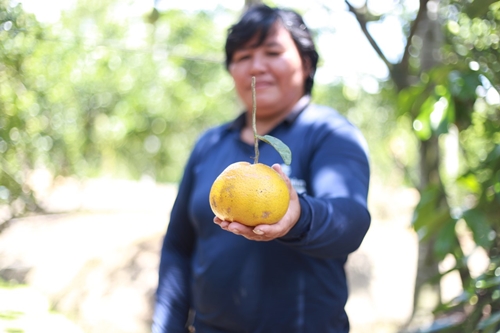
It is a plant that is native to Malaysia. Then it spread to various countries. In Thailand, it is grown mainly in Samut Songkhram province. It is the largest orange after the pomelo. It is a perennial plant with smooth leaves and oil glands. The fruit is round in shape and large, with an orange outer rind, peeled off, easy to peel, and used to make orange juice. and is an offering fruit during the Chinese New Year festival “The villagers gave the same information that In the past, villagers from other places used to plant Kaew oranges as well, but they didn't grow because the area of Ban Bang Sakae was rectangular in shape. There is water surrounding it like an island, so the soil in this area is constantly flooded. and minerals are brought in Makes the soil more fertile than anywhere else So Kaew oranges grow well.” With the current education system focusing on competition to get good grades. and have a good job
As a result, most Thai children and youth are far away from their home communities. Many people forget good things. existing in the community until they do not see the "value" of the good things in their own land of birth But today there is a group of children and youth from Bang Sakae Subdistrict, Bang Khonthi District, Samut Songkhram Province. Volunteer yourself and your heart to learn about "Somkaew", a famous fruit of the subdistrict. Until awareness and love for Somkaew was born with all my heart.
Samut Songkhram or Mae Klong City is a city that has "3 water ecosystems" including fresh water, brackish water, and salt water, making this area have perfect water conditions all year round. There is soil that is rich in minerals. Suitable for making a living through fishing and agriculture, resulting in many unique products. Most people are probably familiar with the large white pomelo, lychee, or mackerel, which has a unique characteristic of its bent face and broken neck.
There is also “Kaew Orange,” a fruit whose name may not be familiar to the general public. Because it is special in that it can only be grown in the area of Bang Sakae Subdistrict, Bang Khonthi District. The orange flesh has a taste similar to a tangerine. But it's sweeter and juicier. When the fruit is ripe it will have a beautiful golden color. Until people in the area like to bring it as an auspicious fruit to use in worship ceremonies.
But the number of somkaews has become less and less. Because it is a plant that is difficult to care for and bears fruit only once a year
A group of youths in Bang Sakae Subdistrict, consisting of Aom-Paphawadee Bunmak, Kik-Nawaphon Kosanam, Joy-Busayakorn Rung-Uthai, James-Athit Tanprasert and Sudarat Srisuwan, view that if the Somkaew situation is allowed to be like this, this next They may be the last generation to see a glass orange. So we joined together to do it. “Som Kaew Project must be STRONG” under the project Power of Children and Youth for Learning in the Western Region Supported by the Thai Health Promotion Foundation (Thai Health Promotion Foundation) and the Siam Commercial Foundation. Siam Commercial Bank Public Company Limited, hoping to help encourage farmers not to stop growing kumquats. And it is an inspiration for people in the community to turn around and help conserve more Kaew oranges.
“In the past, gardeners used to grow kumquats in their gardens. But because it is a plant that is difficult to take care of It bears fruit once a year. When any trees die, no more are planted. So there are fewer and fewer oranges left,” Aom tells of his concern for good things in his hometown. Until I couldn't keep quiet until Somkaew disappeared.
They all started their work by going together to learn about Som Kaew at Kik's house. Team member growing kumquats in the garden Found interesting information: If in any year Orange Kaew gives good results. Next year the tree will be shabby. and produce less fruit But to truly know, you must ask for information from the farmers directly. Therefore, when there was a meeting of villagers at the Bang Sakae Subdistrict Administrative Organization, the team used this opportunity to ask for information from the villagers who attended the meeting. There are both people who plant and people who have stopped growing Kaew Kaew.
The answer made the team understand. “The reason why people stop growing kumquats” is that growing kumquats has a complicated care method. Must be planted in the shade The fruit must be wrapped in banana leaves to get a beautiful golden color. and must also be careful of insect pests Plus, they spend a lot of time taking care of them.
While the produce can only be harvested once a year. Villagers therefore turned to planting other types of crops instead.
As for the group of gardeners who still grow kumquats, they said that “Although the care process is many But it's worth the rewards you get. Because the price of oranges is good.”
During this visit, in addition to the team gaining information about Somkaew, It also helps to encourage the villagers to know that There is a group of young people who are interested in the story of Somkaew.
The team then took the information from the discussion and drew it on a map to mark gardens that have kumquats and found that at present in Bang Sakae Subdistrict there are only 7 orchards that grow kumquats as the main crop, but the information obtained is not yet Enough to revive Somkaew's life again.
The team said that before motivating others to love Somkaew They must understand Somkaew deeply. Both the physical story and the feelings of love for Somkaew in their own hearts. Therefore, villagers who still grow Kaew oranges were invited to a special meeting. The villagers gave full information. Including the history of Kaew oranges, planting, caring for, and harvesting. As well as the contributing factors that made Bang Sakae the only area in the province where kumquats can be grown, doubts have been cleared up.
“The villagers gave the same information that In the past, villagers from other places used to plant Kaew oranges as well, but they didn't grow because the area of Ban Bang Sakae was rectangular in shape. There is water surrounding it like an island, so the soil in this area is constantly flooded. and minerals are brought in Makes the soil more fertile than anywhere else So Kaew Som grows well.” Aom passed on the knowledge he had heard from the villagers.
When the information is clear The team chose to visit the garden of Phuyai Sangieam Songhiran, which is a complete orange orchard. Both varieties and oranges are sold. By studying from breeding, planting, and harvesting. and techniques for taking care of small kumquats, such as sprinkling salt around the trees to improve soil condition, watering, and using biological fertilizers. Until receiving much more information than the team had intended.
From plants
that were deeply unknown in yesterday
Today, the knowledge about Somkaew is
embedded in the team's body. So they
took the information from asking the
villagers. And from studying the actual
area, compiling it into a timeline
(Timeline) tells the story of Kaew
oranges that have been planted in
Thailand since the reign of King Rama II
to use as a forum to return information
to the community. With the hope that
Revealing the information learned will
encourage villagers to see the value of
oranges. and turned back to planting
more
Somkaew's hopes began to show bright signs. Meanwhile, working youths themselves have begun to show signs of change in a positive direction from “Learn through hands-on action” in the project, with “courage” being a skill that every team member has developed throughout. From things that have never been done, From never having spoken, I have spoken. Know how to interact with villagers until it creates a good relationship between children and adults.
Kik said, “This project has made her get to know her hometown more. Closer to people in the community than before.”
As for Aom, he said Learning the ways of gardeners This made her turn to helping the family garden more. From before, when my mother invited me to go to the garden, I sometimes went and sometimes didn't. Because I'm tired and hot. But now, no matter how tired and hot I am, I want to help my mother. Because I want to lighten my parents' burden. and would like to use the knowledge gained to improve the garden as well. Taking responsibility for working on a project also trains her. “Be responsible for your own duties” by being able to manage your time between studying and doing activities well
“During the project I was constantly protested by friends in class. Probably devoted a lot to studying because I'm in Mathayom 6 and have to take the university entrance exam. But I think this is a kind of learning. knowledge in books If we read, we gain knowledge. But knowledge outside the book If we don't take it upon ourselves to learn We won't know. To have to have a double burden other than in the classroom. The work creates a mental impact on all the team members who say with the same voice that If I didn't have this project, I wouldn't know this much about Somkaew. Because they probably don't care about their own home. I don't care what good things my own subdistrict has. I don't care why there are so many oranges in Bang Sakae subdistrict only. A sense of love for one's homeland was rekindled and firmly rooted in the hearts of the team. As well as the impact of the work of the team which has brought joy to the gardeners in the area. that the new generation is interested in agriculture that provides food for the people in the community and was proud of his orange-kaew farmer's career Until it can be expected that the future of Somkaew will definitely not disappear from Bang Sakae.
Source:
https://th.wikipedia.org/wiki/%E0%B8%AA%E0%B9%89%E0%B8%A1%E0%B9%81%E0%B8%81%E0%B9%89%E0 %B8%A7 But I am confident that I will be able to take the university entrance exam. Because after returning from participating in activities I always read the textbook or finish the homework I left behind.”
https://www.isranews.org/content-page/item/55244-strong.html