
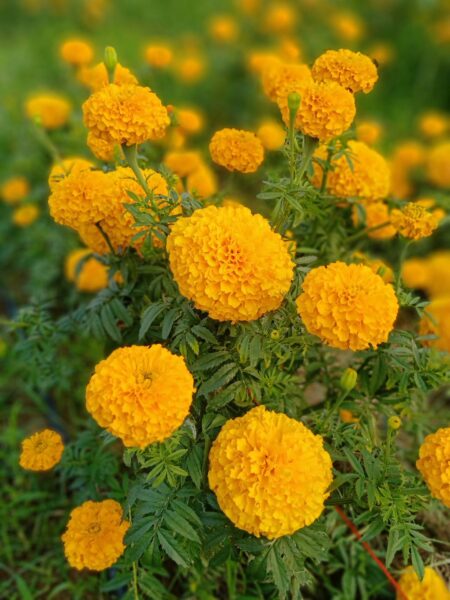
calendula
Scientific name: Gynura hispida
Family name: COMPOSITAE (ASTERACEAE)
Botanical characteristics: Herbaceous plant, 75-100 cm tall, rarely branches except when in flower. Succulent, purple, hairy stems. Single, alternating, lance-shaped, broad leaves.1.5-3 cm., 5-10 cm. long, leaf tips pointed, leaf bases smooth, serrated fiber edges, teeth sparse and shallow. There are feathers on both sides. The flowers are tightly clustered and come out singly. Or gathered into a cascading bouquet of 2-7 at the tip of the shoot. Decorative leaf shelf in the shape of a person The bracts are lanceolate with purple tips, 2-2.5 mm wide, 8-10 mm long. The flowers are orange-yellow, the petals 8-10 mm long. The dried fruit has flaked seeds. The shape is parallelogram-shaped, 3-4 mm long. The surface is smooth or there are hairs between the ridges.
Important substances : triterpene glycoside 10 types is calendulaglycoside A (1), calendulaglycoside A 6´-O- methyl ester (2), calendulaglycoside A 6´-O-n- butyl ester (3), calendulaglycoside B (4), calendulaglycoside B 6´-O-n- butyl ester (5), calendulaglycoside C (6),calendulaglycoside C 6´-O- methyl ester (7), calendulaglycoside C 6´-O-n- butyl ester (8), calenduloside F 6´-O-n- butyl ester (9) และ calenduloside G 6´-O- methyl ester (10)
and substances in the group flavonol glycoside 5types is isorhamnetin 3-O- neohesperidoside (11), isorhamnetin 3-O- 2G-rhamnosylrutinoside (12), isorhamnetin 3-O- rutinoside(13), quercetin 3-O- glucoside (14) และ quercetin 3-O- rutinoside (15) which was isolated from western marigold flowers. It was found that substances 1-9 had anti-inflammatory effects in mice induced with ear inflammation with 12-O- tetradecanoyl phorbol-13-acetate (TPA) with a value of ID50 ( 50% inhibitory dose) is between 0.05-0.20 mg/ear and substances 1-10 have the effect of resisting the stimulation of Epstein-Barr virus early antigen (EBV-EA) from induction with TPA, with a value of IC50 (50% inhibiotry concentration) ) was between 471-487 mol ratio/32 pmol TPA and found that substances 9,10 were toxic to colon cancer cells. Leukemia and melanoma cells
Parts used: Flowers, roots, leaves, stems
Properties: Nourishes eyesight, nourishes skin, reduces wrinkles, relieves skin disease, treats acne, relieves internal heat, relieves hearing pain, dissolves phlegm, relieves cough. Dizziness glass Helps reduce blood sugar Reduce blood fat, expel gas, relieve constipation, treat hemorrhoids. Relieve menstrual pain Antioxidants
Origin : http://medplant.mahidol.ac.th/pharm/botanic.asp?bc=0608&kw=%B4%D2%C7%E0%C3%D7%CD%A7