
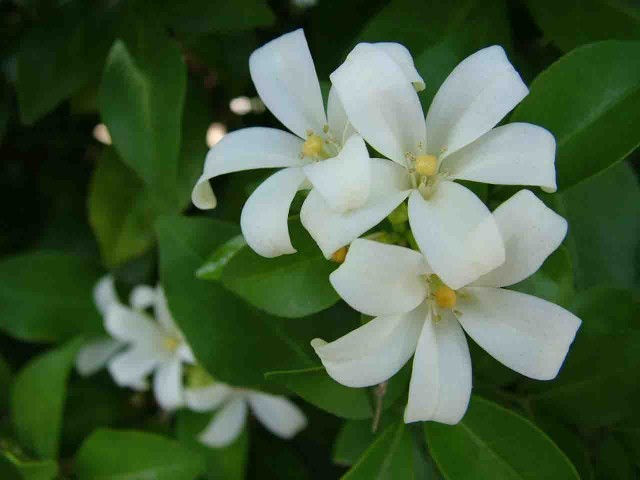
Tonkaew
Local name: Kaew Khao (Central)/ Kaew Khi Kai (Yala)/ Kaew Prik Talai Kaew (North)/ Kaew Lai (Saraburi)/ Ja Prik (Lampang)
Common name: Andaman satinwood/Chinese box tree
Scientific name: Murraya paniculata (L.) Jack
genus Murraya
paniculata species
Synonym
Camunium exoticum (L.) Kuntze
Chalcas cammuneng Burm.f.
Chalcas intermedia M.Roem.
Chalcas japanensis Lour.
Chalcas paniculata L.
Family name: RUTACEAE
Botanical characteristics
Stem: small perennial plant, 3-8 m tall. Can be pruned to form a bush. Does not shed leaves. Bark is cream colored. Broken into long grooves
The leaves are compound, feather-like leaves with odd ends. The leaves are arranged alternately with 3-9 leaflets. The leaves are oval-shaped. The uppermost leaf is lance-shaped, 1.5-4.0 cm wide, 2-10 cm long. The leaf base is wedge-shaped or crooked at the base. The leaf tip is pointed. The leaf margins are smooth. The leaves are hard and thick. The leaves have oil glands. When crushed, there will be a pungent smell. The upper surface of the leaves is dark green. The surface is smooth and shiny. The lower surface of the leaf is light green.
Flowers: clusters of flowers in a short cluster at the tip of the shoot. Flower stalk 0.5-1.0 cm long, calyx light green. 5 triangular petals, 5 oval white petals, rounded or pointed tips. Petals fall off easily The flowers are fragrant at night. Flower diameter 1-2 cm. Stamens 10, 5 short, 5 long. The ovary is above the petal ring.
Fruit Fresh orange-like fruit, oval or egg-shaped, young green fruit. The fruit is reddish-orange. The oil glands are clearly visible and are 0.5-0.8 cm wide and 0.8-1.3 cm long.
eeds are oval shaped, with thick, tough hairs surrounding the seed. Each fruit contains 1-2 seeds.
Ecological conditions
outdoor
ecological conditions
Grows sparsely in the rainforest. or on a limestone mountain Found at a medium height of 600 m above sea level. When planted outdoors, it will have bushy shrubs and lots of flowers.
Place of origin
South Asian countries Southeast Asia, China and Australia
Distribution
China, Japan, Korea, India and the Indochina region
Planting and propagation
Loamy soil, sandy loam, lots of sunlight, propagated by seeds, cuttings.
Flowering period
All year long
Fruiting period
All year long
Utilization type
Herbs, ornamental plants, woody plants
Fresh roots have a calm, spicy flavor. Boiled with water to treat bruises. Used as a poultice for wounds Dried roots, cut into fine pieces, stewed with pig's tail mixed with liquor, eaten to relieve aches and pains.
dry roots and stems Sliced, boiled, simmered, then filtered, the water is used to help speed up childbirth. Using a bandage dipped in solution, insert it into the cervix. Cure itchy rashes caused by humidity Antidote for insect stings
Fresh stems and leaves have a hot, bitter taste. Grind and soak in alcohol for 24 hours, use topically or as an injection as a pain reliever. Boiled mouthwash to relieve toothache Rod used to clean teeth The branches and leaves are used to treat AIDS.
The leaves are a remedy for colic and nourish the blood. - Wood for making Saw Duang, Saw U.
note
Sa Kaeo Provincial Flower
Source : https://www.royalparkrajapruek.org/Plants