
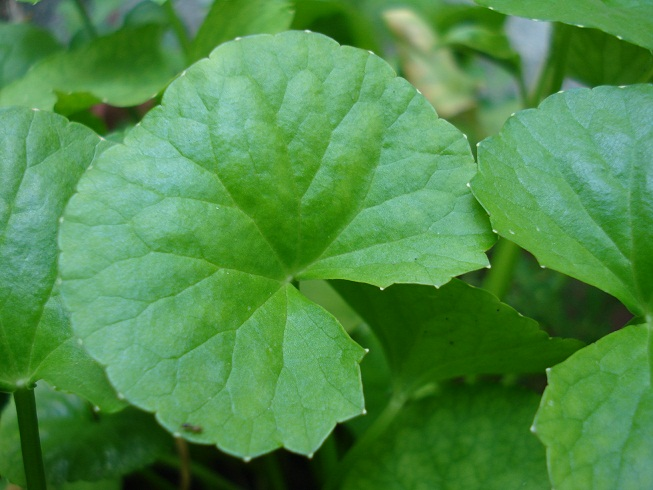
Gotu kola
Local name Phak Waen (Central, North)/ Phak Nok (South, North)
Common name Asiatic pennywort/ Spadeleaf
Scientific name: Centella asiatica (L.) Urb.
Genus Centella
Synonym
Centella boninensis Nakai ex Tuyama
Centella glochidiata (Benth.) Drude
Centella hirtella Nannf.
Centella tussilaginifolia (Baker) Domin
Centella ulugurensis (Engl.) Domin
Centella uniflora (Colenso) Nannf.
Chondrocarpus asiaticus Nutt.
Chondrocarpus triflorus Nutt.
Glyceria asiatica Nutt.
Glyceria triflora Nutt.
Hydrocotyle asiatica L.
Family name: APIACEAE
Plant group
flowering plants
Botanical characteristics
The trunk is a herbaceous plant that is several years old. The trunk flows and crawls along the wet soil. It grows easily. It has fibrous roots emerging from the joints. The leaves stand upright and grow out from the original plant.
Leaves are single or in groups of up to 6, arranged alternately. The leaves are kidney-shaped with a narrow or wide concave base. The leaves are 0.8-9.0 cm wide and 0.8-5.5 cm long. The leaf tips are rounded and the edges are serrated. The leaves have green The surface is smooth or slightly hairy. The petiole is 0.3-30.0 cm long.
Flowers appear in clusters along the leaf axils, with 1-7 small flowers. The petals have 5 petals, red-green to purplish red.
The fruit is a dry, cracked, flat fruit with black seeds.
Ecological conditions
shaded
ecological conditions
Gotu Kola is a plant that likes partial sunlight. Needs moderate water. and wet soil
Place of origin
Tropical-temperate Asia, Africa, Pacific Ocean
Distribution
Africa except northern and Asia It has been cultivated in Brazil, Colombia, and Hawaii.
Planting and propagation
Propagated by seed. Or separate the seedlings and roots that have grown and then plant them.
Utilization type
food, herbs
The whole plant has a cool, fragrant flavor, relieves internal bruising, is a diuretic, heals wounds, and relieves heat and thirst. Cure one-sided headaches (migraines), cure leprosy, cure venereal disease, cure hepatitis, nourish the heart, nourish strength.
The leaves have a bitter taste and are used as a medicine to quench the heat. Reduces inflammation and swelling, relieves stomach pain, dysentery, and jaundice. Leaves are boiled with rice water. Eating to cure stones in the urinary tract Pound it in a poultice or boil it in water and eat it to cure abscesses and measles. Boil it with red pork and eat it to cure whooping cough.
The seeds have a cool and bitter taste, treat dysentery, fever, and headache.
Origin : https://www.royalparkrajapruek.org/Plants