
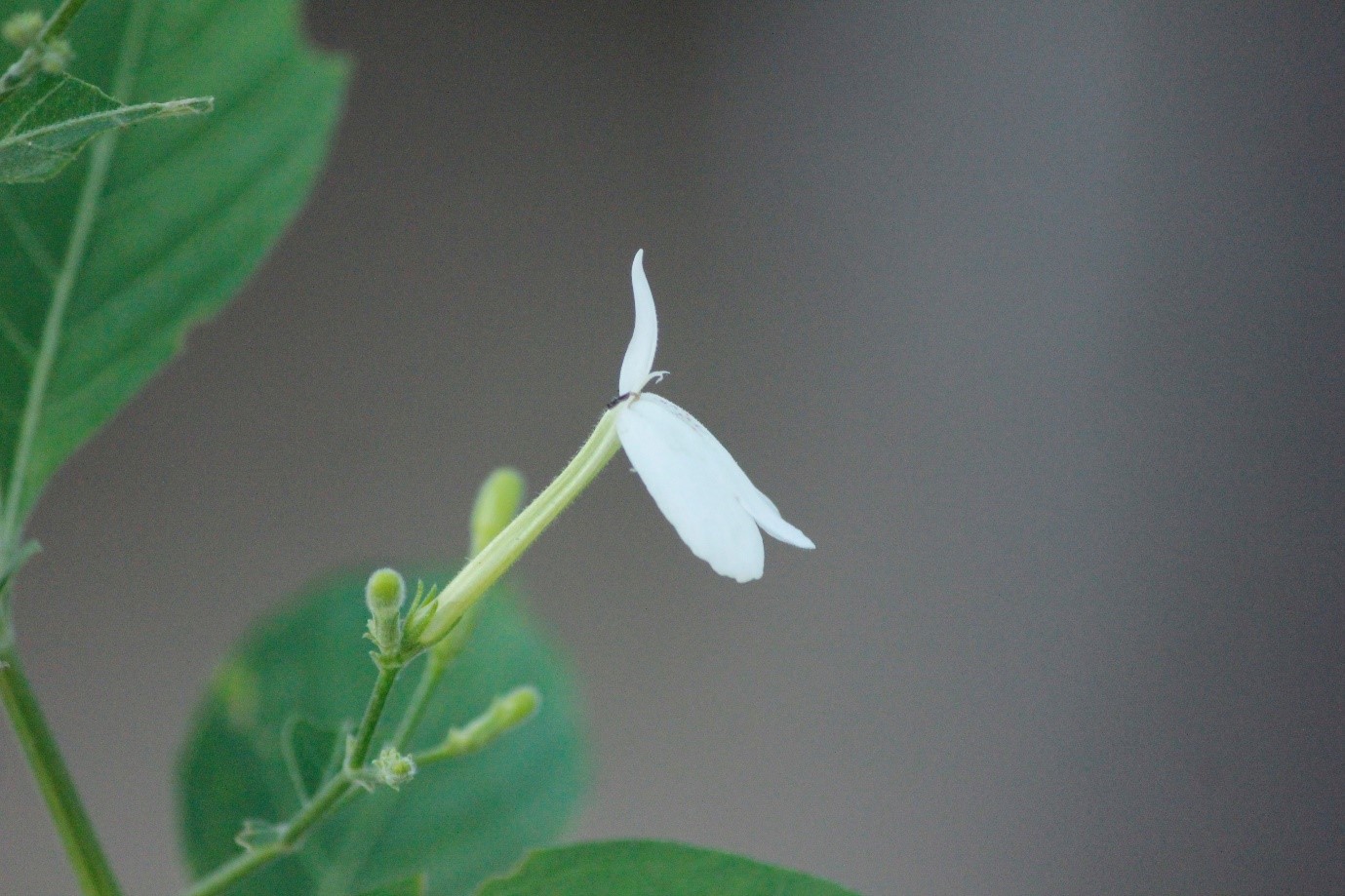
gold panchang
Local name: Thong Khan Chang, Ya Man Kai (Central Region)
Common name: Snake jasmine
Scientific name: Rhinacanthus nasutus (L.) Kurz.
Genus Rhinacanthus
nasutus species
Synonym
Rhinacanthus nasutus (L.) Kuntze
Dianthera paniculata Lour.
Justicia nasuta L.
Pseuderanthemum connatum Lindau
Rhinacanthus communis Nees
Rhinacanthus nasutus (L.) Kuntze
Rhinacanthus osmospermus Bojer ex Nees
Family name ACANTHACEAE
Botanical characteristics
Shrub up to 120 cm tall. Young branches and trunk. Usually has a square ridge. The young parts are often covered with hair. The base of the trunk is a hard core.
Leaves are simple, opposite, oval, oval or oval. The leaf base and tip are pointed, 2-3 cm wide, 4-6 cm long.
The flowers come in short clusters in the leaf axils. The calyx has 5 petals. The petals are white. The base is connected together to form a tube about 2 cm long. The tip is divided into 2 lobes.
The fruit is a long, slender pod containing 4 seeds.
Ecological conditions
outdoor
ecological conditions
Found at an altitude of 750 m above sea level.
Grows best in moist, well-drained soil. But it is also found in very dry habitats, such as rock cracks.
Place of origin
It is native to Cambodia, Bangladesh, Comoros, Angola, and Madagascar.
Distribution
China, Cambodia, Indonesia, Laos, Malaysia, Burma, Thailand, Vietnam, India, Sri Lanka, Philippines, Madagascar.
Planting and propagation
Propagate by planting seeds and cuttings.
Utilization type
herbs, ornamental plants
Leaves and roots treat ringworm, ringworm, and itchy rashes by using fresh leaves and roots, pounding them thoroughly, soaking in liquor for 1 week, applying the liquor to the affected area 2-3 times a day.
The leaves have a cool, bitter taste that extinguishes fever and cures fever. Cure skin parasites Take fresh or dry roasted leaves. Come brew it in drinking water. It is a diuretic, laxative.
The roots have a bitter, intoxicating flavor and cure ringworm, rashes, and some types of lymphatic skin diseases.
Origin : https://www.royalparkrajapruek.org/Plants