
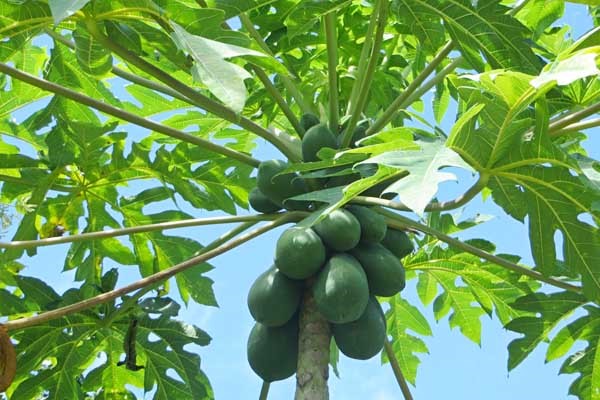
papaya
Local name: Kuayla (Yala) / Watermelon (Satun) / Makuay (Northern Region) / Loko (Southern Region) / Fermented Hung (Nakhon Phanom, Loei)
Common name Papaya/ Pawpaw
Scientific name: Carica papaya L.
Genus Carica
Synonym
Carica citriformis J.Jacq. ex Spreng.
Carica citriformis Jacq.
Carica cubensis Solms
Carica hermaphrodita Blanco
Family name CARICACEAE
Group of plants, flowering plants
Botanical characteristics
Trunk, many years old, 3-6 m tall, smooth bark. Brown to white, straight stem, no pith, few branches. There are clear leaf scars and thick white sap.
Leaves are single, arranged alternately around the plant, densely at the tip. Palm-shaped leaves, size 80-120 cm., the edges of the leaves are concave and deeply lobed to the axis. The leaf petioles are tube-shaped, hollow, 25-100 cm long.
Flowers are separated by gender on different plants. Male flowers come in long, hanging bouquets. The flowers are white with 5 petals and are fragrant. The female flowers are white. It comes out in clusters in the leaf axils. The flowers are large. than male flowers
Fruit fusiform, smooth surface, thin peel, has white rubber. Fresh, dark green fruit. When ripe it turns orange and is edible. It has many seeds.
Seeds are round, black, with a clear white seed coat.
Ecological conditions
shaded
ecological conditions
Tropical and subtropical climates
Place of origin
in South America and North America
Distribution
Grown in tropical and temperate countries.
Planting and propagation
Propagated by seed.
Utilization type
Food, herbs, ornamental plants, economic crops
The ripe fruit has a sweet taste and is used as a medicine to prevent or cure scurvy. It is a laxative, nourishes breast milk, and improves appetite.
The raw fruit is bland in taste and acts as a carminative, diuretic, relieves urinary incontinence, and drives out parasites.
The sap from raw fruits is a digestive aid and kills parasites.
Roots have a bitter and pungent taste. Boil and drink to cure urinary tract infections, gonorrhea, diuretic, improve appetite, cure white mutkitra, nourish breast milk.
The leaves have a strong flavor and are boiled to drink to nourish the heart, expel parasites, cure fever, dysentery, pneumonia, and arthritis. Cure elephantiasis Pouring paste on chronic wounds, abscesses
Origin : https://www.royalparkrajapruek.org/Plants