
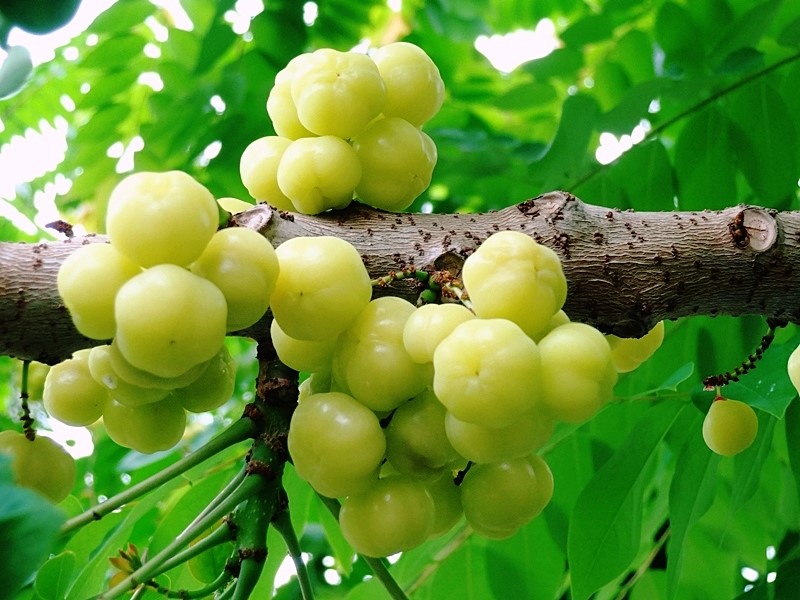
star gooseberry
Local name Mak Yom Mak Yom (Northeast)
Common name: Star gooseberry
Scientific name: Phyllanthus acidus (L.) Skeels.
genus Phyllanthus
acidus species
Synonym
Averrhoa acida L.
Cicca acida (L.) Merr.
Cicca acidissima Blanco
Cicca nodiflora Lam.
Diasperus acidissimus (Blanco) Kuntze
Family name PHYLLANTHACEAE
Plant group
Perennial plants
Botanical characteristics
A small perennial tree, 5-10 m tall. The trunk is straight and has dense branches at the top. The branches are brittle and break easily. The bark is rough and has brown patches.
The leaves are deciduous. The leaves are alternately arranged, single plane, on branches about 15-30 cm long, resembling compound leaves. Each branch has 20-30 pairs. The leaves are oval, oval-lanceolate, parallelogram-shaped or rather rectangular, rhombic, wide. 1.3-3.5 cm., 2.5-7.5 cm long, leaf base rounded, leaf tip pointed, leaf edge smooth, leaf surface smooth.
Flowers come in clusters along the branches. The inflorescence is 5-10 cm long. The flowers are separated from each other on the same plant. Male flowers occur at the tip of the inflorescence, with 6 separate sepals, no petals, 3 stamens. Female flowers have 6 red-pink sepals, succulent, and have a sour taste.
The fruit is round and flat with 6-8 grooves, 1-2 cm in diameter. The young fruit is green when mature and turns yellow or yellowish-white when mature.
Seeds: The seeds are round in shape and have a hard side, light brown in color and 1 seed. The fruit is soft when ripe.
Ecological conditions
outdoor
ecological conditions
Found at an altitude of 200-2,300 m. above mean sea level.
Place of origin
Brazil
Distribution
Cambodia, India, Malaysia, Burma, Nepal, Philippines, Sri Lanka, Thailand, America
Planting and propagation
Cuttings, planting seeds
Flowering period
All year long
Fruiting period
All year long
Utilization type
food, herbs
Young shoots are eaten as a vegetable.
The roots treat fever, treat skin diseases, treat rashes and rashes. Dry lymph fluid
The leaves are an antidote for itching, headaches, measles and chicken pox.
Results of cancer treatment Helps delay aging and the degeneration of various cells in the body. Helps extinguish heat and balance, extinguish phlegm toxins, laxative, elixir of longevity, and nourishes the blood.
Mature fruits have a sour taste, eaten as fruit, pickled or preserved.
Origin : https://www.royalparkrajapruek.org/Plants