
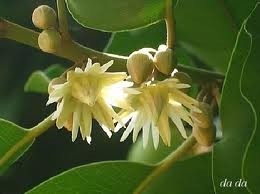
bullet wood
Local name: Sang Dong (Lampang)/ Phikun Khao Pikun Thuean (Nakhon Si Thammarat)/ Phikun Pa (Satun)/ Kaew (Northern Region)/ Kun (Southern Region),
Common name: Bullet wood/Spanish cherry
Scientific name: Mimusops elengi L.
Genus : Mimusops
Species : elengi
Synonym
Imbricaria perroudii Montrouz.
Kaukenia elengi (L.) Kuntze
Kaukenia javensis (Burck) Kuntze
Kaukenia timorensis (Burck) Kuntze
Magnolia xerophila P.Parm.
Family name: SAPOTACEAE
Plant group
Perennial plants
Botanical characteristics
Trunk: Medium-sized perennial plant, 8-15 m tall. All parts contain white latex. The canopy is dense and dark green. Spreads widely into an upright or pagoda-shaped bush. The brown bark cracks into shallow grooves lengthwise. Young branches are covered with reddish-brown hairs.
The leaves are deciduous. The leaves are alternately arranged, oval, oval, or parallelogram-shaped, 2-5 cm. wide, 5-10 cm. long. The leaf base is rounded, the leaf tip is pointed. The leaves are leather-like. The leaf margins are smooth. The back of the leaves is dark green. The surface is smooth and shiny. The underside of the leaves is light green. There is a reddish-brown color on the midribs of the leaves.
Flowers: Single flowers or clusters of 3-5 flowers. Flowers appear in leaf axils. The flowers are 1.0-1.5 cm in diameter with 8 yellowish-brown sepals. Separate sepals arranged in 2 rings of 4 petals each, oval-shaped. The outer surface is covered with reddish-brown hairs. Cream colored petals The base is connected together to form a short tube. The tip is divided into 24 lanceolate lobes arranged in 3 whorls, 8 petals per whorl. The stamens are 16, complete, 8 incomplete. The ovary is above the whorl.
Fruit Fresh fruit is oval or oval, width 1.0-1.8 cm., length 1.5-3.0 cm. Young fruit is covered with brown hairs and this hair will fall off. Ripe fruit is red with yellow flesh. There are sepals attached.
Seeds: 1 seed
Ecological conditions
outdoor
ecological conditions
Grows well in all types of soil. It needs a kettle of water and moderate humidity. It likes lots of sunlight.
Place of origin
India, Sri Lanka, Thailand, Burma, Indochina and in the Andaman Islands.
Distribution
Asia
Planting and propagation
Grafting and planting seeds
Flowering period
All year long
Fruiting period
All year long
Utilization type
Herbs, ornamental plants, shade plants
plant to decorate the place
The flowers have a cool scent. Used to flavor cosmetics, into perfumes, snuff, to relieve gas, fever, nourish the heart, relieve headaches, relieve sore throat, relieve internal heat, astringent, relieve diarrhea, nourish the blood, relieve muscle aches. Phikun flowers according to Thai medicinal properties Arrange in a medicine that coordinates with all 5 pollen or use in combination with other flowers. which has a fragrant scent to make potpourri
The raw fruit and astringent bark cure fever and diarrhea.
The astringent bark of the tree is used as a remedy for gingivitis.
The leaves have an astringent flavor that cures venereal disease, asthma, and kills parasites.
The seeds are a diuretic and treat constipation. The roots have a bitter, astringent taste and are used as a blood tonic, a cure for phlegm, and gas. The core has a bitter and astringent taste. They are a blood tonic and a fever remedy.
Khon Dok is a Thai medicine. May come from old Phikun or Tabaek trees. There is a fungus growing into the wood. But in the past it was said that the flowers obtained from the Phikun tree were of better quality. The flowers are fragrant and tasteless. They have the properties of nourishing the liver, lungs and heart, nourishing the fetus (pregnancy), and rejuvenating the heart.
Origin : https://www.royalparkrajapruek.org/Plants