
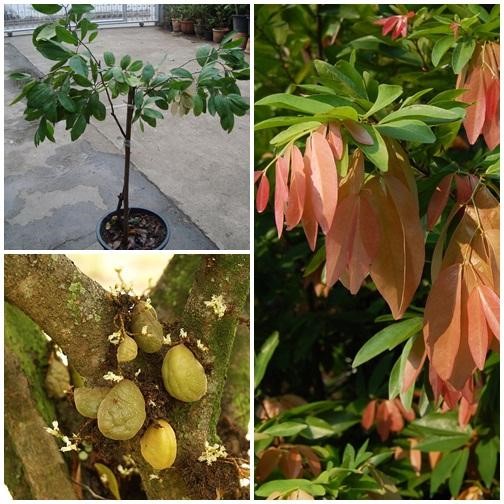
Amphawa tree
Common name: Nam nam
Scientific name: Cynometra cauliflora
Family: LEGUMINOSAE
Components of a tree
Characteristics of the trunk
Amphawa is a tree species with a dense, beautiful canopy. The trunk has a height of about 3-15 meters and the bark is brown-gray. The older the tree is, The denser the bush will be.
blade
The leaves of Amphawa look like two leaves together, but actually they are two leaves combined into one. The leaves are bright green, smooth and shiny. Young leaves are light green and pinkish. Long, curved appearance The tip of the leaf is rounded and pointed. It will be assembled like a double-ended feather. Arranged alternating with a central core, 20-30 centimeters long, with 2-4 pairs of leaves, diamond-shaped with parallel edges. The width is about 3-5 centimeters and the length is about 10-15 centimeters. The base of the leaf is pointed and crooked. The leaf edge is smooth. The leaf blade is thin but quite tough. The leaf stalk is about 0.5 centimeters long.
flower
The flowers of the Amphawa tree bloom in clusters of white or cream colored flowers along the trunk. It has white-pink petals. which will grow out in a bouquet-like bouquet on the large branches and trunk The inflorescence hangs 3-5 centimeters long and is a small flower. The calyx base is connected together to form a tube. The tip is divided into 5 lobes, spoon-shaped. The petals are thin and streaked. There are 10 stamens. The diameter of the flower is about 0.5-0.8 centimeters and the flower stalk is covered with brown scales.
result
The fruit of Amphawa is flat and looks like a kidney. The surface of the Amphawa fruit is rough and bumpy. When the fruit is still young, it will be brownish-green. And when the fruit is ripe, it will become yellow. Weighing approximately 200 grams, the raw fruit has a sour taste similar to raw mangoes, while the ripe fruit has a sweet and sour taste. The fruit will be ripe after about 2-3 months of coming out. Fruit will come out during June-August every year.
Other benefits or properties
- Mature fruits can be eaten fresh or boiled in sugar to make fruit salad as well.
- The bark and roots can be used to treat blood diseases and cancer.
- Amphawa is a plant with a beautiful canopy and leaves. Can be planted as a fruit tree in the garden. Or you can plant it in a pot as an ornamental bonsai plant as well.
- In Malaysia, Amphawa fruits are used in cooking. And can also be made into seasoned fruit sauce.
- The fruit of Amphawa can also be made into compote. If the fruit is young, it can be pickled and stored.
- Amphawa fruit can be made into a savory dish stir-fried with chili. Or you can boil it with fish as well.
refer: http://www.lib.kps.ku.ac.th/SpecialProject/Horticulture/2547/Ms/JamluangHa/chapter4.pdf