
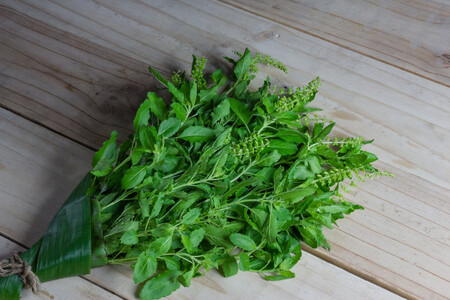
sweet basil
Scientific name: Ocimum tenuiflorum L.
Family: LAMIACEAE
Common name: Holy Basil, Sacred Basil
Other names/common names: (Central region) White basil, Red basil, House basil (Northern region) Komko, Kamko, Komkodong (Northeastern region) Thai E-Tu vegetable
Characteristics: There are 3 varieties of basil: red basil, white basil and hybrid basil between Red basil and white basil It has general characteristics similar to basil. They differ in their smell and the branches which have hair. more covered light green white basil leaves The red basil leaves are greenish-purple-red. The flowers are pinkish-purple. Red basil flowers are darker than white basil.
Medicinal benefits: Thai medicine texts use the leaves or the whole plant as a carminative to relieve stomach pain, diarrhea, and nausea and vomiting. It is more popular to use red basil than white basil. Use 1 handful of fresh shoots, boil until boiling, and drink only the water. It was found that the carminative effect was caused by essential oils. Animal experiments show that the juice of whole plant extracts has the effect of reducing Peristalsis of the intestines Alcohol extract can treat stomach ulcers. The eugenol substance in the leaves has a bile-distilling effect. Helps digest fat and reduce colic symptoms.
Important chemicals and nutrients: Apigenin, Ocimol, Phenols, Chavibetol, Linalool, Organic Acid. Contains quite a lot of vitamin A and phosphorus. There is also vitamin C, minerals and other vitamins.
Reference source
: https://pharmacy.mahidol.ac.th/medplantdatabase