
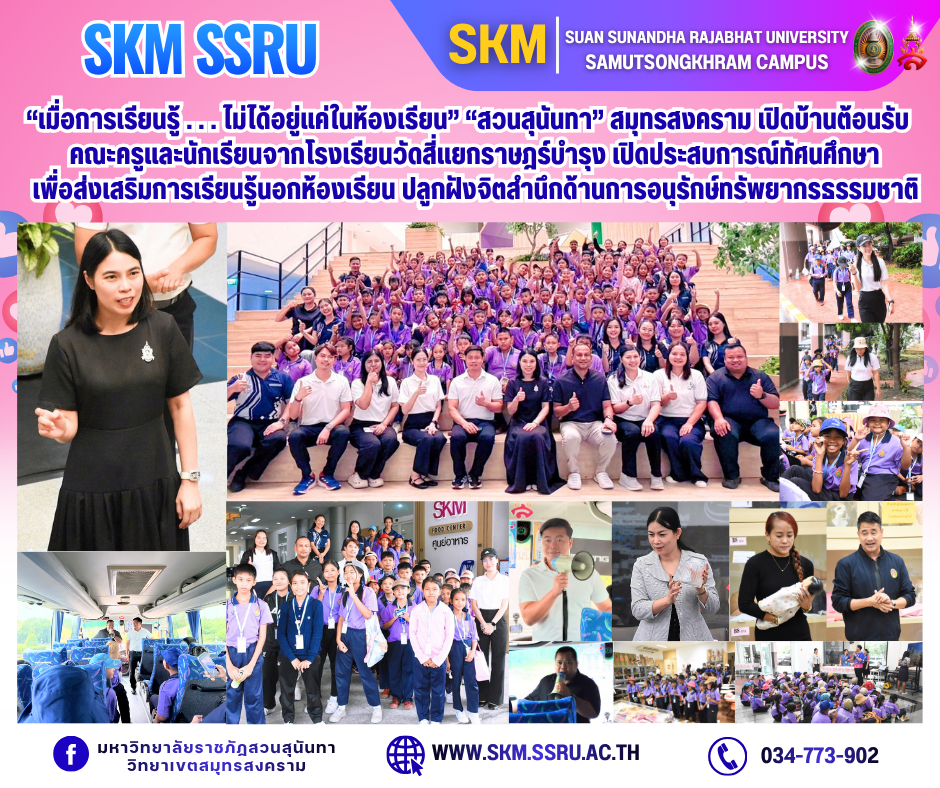
Suan Sunandha Rajabhat University, Samut Songkhram Campus, led by Assistant Professor Dr. Pimporn Thongmuang, Vice President for Samut Songkhram Campus, together with Mr. Ekknarin Piyapanyamongkol, Acting Director of the Samut Songkhram Campus Office, and Mr. Ekkachon Peerathanan, Director of the General Affairs Division, Samut Songkhram Campus Office. Staff from the Samut Songkhram Campus Office welcomed teachers and students (Grades 1–6) from Wat Si Yaek Rat Bamrung School for a field trip and a tour of the learning facilities at Suan Sunandha Rajabhat University, Samut Songkhram Campus. The event took place on Tuesday, October 6, 2026, at the university's Samut Songkhram Campus.
The objective is to promote learning outside the classroom, instill a sense of awareness regarding natural resource conservation, and provide students with the opportunity to experience an integrated learning process through participation in four learning stations, namely:
College of Allied Health Sciences Station – Demonstration of herbal powder preparation and a tour of the Thai Traditional and Integrative Medicine Hospital.
College of Nursing and Health Station – Tour of the virtual simulation laboratory used for practical training by students of the College of Nursing and Health, Suan Sunandha Rajabhat University.
Native Plant Learning Station (Bang Chang Chili and Kitchen Garden Plot) – Learn about the native perennial plants of Samut Songkhram Province and various plant species, while also experiencing hands-on cultivation.
Medicinal Mangrove Plant Learning Station – Study the natural ecosystem surrounding the Samut Songkhram Campus and participate in environmental conservation activities.
Throughout the event, students engaged in learning activities with enthusiasm and enjoyment, evident in the smiles and laughter that filled the atmosphere. This experience offered them the opportunity to encounter real-world situations beyond the classroom, gain new knowledge, and create lasting impressions—ultimately inspiring further interest in science, health, and the environment.
As part of the learning activities, teachers and students explored and familiarized themselves with various medicinal plants, learning about their benefits and practical applications in daily life. They also gained an understanding of the importance of the mangrove ecosystem—a vital natural resource for maintaining environmental balance and supporting the community's way of life. The activities emphasized experiential learning through observation, experimentation, and hands-on practice, as well as the exchange of ideas based on real-life experiences.
This activity aims not only to enhance knowledge about medicinal plants and nature but also to provide a space for students to learn outside the classroom through hands-on experience. It fosters an appreciation for local natural resources and the environment while encouraging young people to develop a sense of responsibility and recognize the importance of participating in the conservation and care of these resources, ensuring their sustainable existence and use for the future.
Report by: Mr. Jirayus Poolsawat
Photos by: Ms. Saranya Noonak / Mr. Jirayus Poolsawat